

Which Fashion Photography Service Does Your Brand Actually Need?
Most e-commerce fashion brands lose sales at the exact moment a customer scrolls past a product image that does not do the garment justice. The product is right. The price is right. The photography is not, and that single gap is enough to send a shopper back to the search results.
The difficulty is that “fashion photography” is not one thing. A knitwear brand launching a new drop needs something different from a boutique building out its product catalogue, and a label preparing a seasonal campaign needs something different again. Choosing the wrong format wastes budget and, in some cases, actively works against conversion.
Below is a breakdown of the five core photography and video formats we produce at Marca Studio, who each one suits, and how to tell which your next shoot should be built around.
Ghost mannequin: The standard for product catalogues
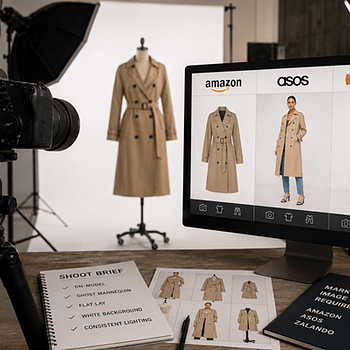
If your customers are buying from a product grid, ghost mannequin photography is the format doing most of the heavy lifting across the industry, and there is a reason for that. It shows the true shape, drape, and construction of a garment without a model or a visible mannequin in the frame, which keeps the customer’s attention entirely on the product.
This format works best for:
- Core catalogue and category page images
- Marketplace listings, where consistency across every seller matters
- Brands with large SKU counts that need a repeatable, efficient shoot process
Where ghost mannequin work falls short is in showing fit and movement. A structured blazer photographs well this way; a jersey dress that needs to skim the body does not communicate the same way without a person wearing it.
Model photography: Selling fit, not just fabric
Model photography answers the question every online shopper is silently asking: how will this actually look on a body. It is the format that builds trust in fit, proportion, and styling, and it is particularly important for categories where cut and drape are the main selling point.
This format works best for:
- Denim, tailoring, and anything with a fitted silhouette
- Lifestyle and campaign imagery for homepage or social use
- Brands wanting to reduce returns caused by uncertainty over sizing
A common mistake is running an entire catalogue on model shots alone. It is a slower, costlier process than ghost mannequin work, so the strongest approach is usually a mix: model imagery on hero pieces and best-sellers, with ghost mannequin covering the rest of the range.
Fashion model videos: Closing the gap between photo and fit
A still image, however well lit, cannot show how a fabric moves. Fashion model videos fill that gap, and product pages featuring video consistently hold visitor attention longer than static imagery alone, which search engines and social platforms both reward.
This format works best for:
- Product detail pages for higher-value or considered purchases
- Fabrics where movement, weight, or stretch is part of the appeal
- Social content, where video already outperforms static posts
Video does not need to replace photography. Most brands use it selectively, on the pieces where seeing the garment in motion genuinely changes the buying decision.
Flat lay photography: Clarity for accessories and layered items
Flat lay photography is the most efficient way to present items that either do not suit a mannequin or benefit from being shown alongside other pieces, such as jewellery, accessories, or a coordinated outfit. It gives full control over composition and styling, which makes it useful for storytelling as well as straightforward product shots.
This format works best for:
- Accessories, bags, and jewellery
- Multi-item outfit shots and capsule collection features
- Blog and social content that needs a consistent, styled aesthetic
Creative photography: Building the brand, not just the catalogue
Catalogue imagery sells the product. Creative photography sells the brand around it. This is the format for campaign work, seasonal lookbooks, and imagery designed to sit on a homepage, in a press feature, or across a social feed, where the goal is standing out rather than simply showing a product clearly.
This format works best for:
- Seasonal campaigns and collection launches
- Homepage and above-the-fold website imagery
- Press, PR, and paid social creative
Choosing the right mix
Very few brands need only one of these formats. A typical, well-run catalogue combines ghost mannequin photography as the backbone of the product range, model photography on key pieces, flat lay for accessories, video on standout items, and creative photography reserved for campaign moments. The right balance depends on the product category, the price point, and where the imagery will actually be used.
If ranking positions or sales for a specific product category have started to slip, it is often a sign the current photography format no longer matches how customers in that category are shopping. Getting in touch with our team is the fastest way to work out which formats your next shoot needs, and where the current gaps are costing you conversions.