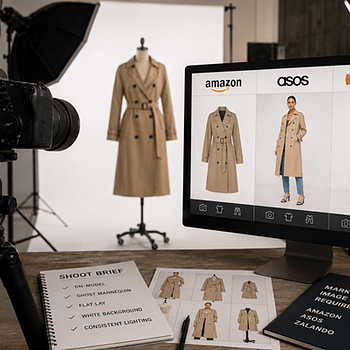


Can AI Replace Fashion Photography? What Brands Need to Know
AI image tools are everywhere right now, and it’s no surprise that fashion brands are asking the question: can we just generate our product photography instead of booking a studio shoot?
It’s a fair question. AI tools are fast, they’re cheap, and the marketing around them promises studio-quality results in seconds. But for fashion e-commerce specifically, where a customer’s entire buying decision rests on trusting what they see, the reality is more complicated than the hype suggests. Here’s what actually holds up, and where AI still falls short of a real studio shoot.
Where AI genuinely helps
To be fair to the technology, there are places where AI has become a useful tool for photography studios, not a replacement for them.
Background clean-up and consistency. Once a garment has been properly shot, AI can help clean up backgrounds, remove dust or minor marks, and keep files consistent across a large catalogue. This is AI working alongside a real photograph, not instead of one.
Speeding up post-production. Basic colour correction, batch processing and minor retouching can be accelerated with AI-assisted tools, freeing up a studio’s retouching team to focus on the details that actually matter, like accurate colour matching and true-to-life fabric texture.
Up scaling and resizing for multiple platforms. Different marketplaces need different image specs. AI can help resize and adapt an original studio image for Shopify, ASOS, Amazon and Zalando without a brand needing to reshoot for every platform.
Used this way, AI is a tool in the studio’s kit, not a substitute for the studio itself.
Where AI still falls short
This is where it matters most for fashion e-commerce, because these are the exact things that drive (or kill) a sale.
Fabric behaviour and drape. How a fabric folds, stretches, catches light, and moves are something AI still struggles to render convincingly. A silk blouse, a structured blazer and a knit jumper all behave completely differently on a body or a mannequin. Generative AI tends to flatten these differences into a generic, slightly “off” texture that a trained eye, and often an untrained one too, can spot immediately.
True colour accuracy. Customers make purchasing decisions based on colour, and returns spike when the colour on screen doesn’t match the product that arrives. AI-generated imagery is prone to colour drift and inconsistency across a product range, whereas a properly lit and colour-calibrated studio shoot delivers accuracy you can rely on, shoot after shoot.
Fit and sizing honesty. Ghost mannequin and model photography exist to show customers exactly how a garment fits and sits in real life. AI-generated “models” and AI-draped garments create an idealised, sometimes physically inaccurate version of a product. That gap between expectation and reality is one of the biggest drivers of returns in fashion e-commerce, something brands are already fighting hard to reduce.
Brand authenticity and trust. Customers are becoming more aware of, and more sceptical toward, AI-generated imagery. For a lot of fashion brands, especially those built on quality and craftsmanship, presenting garments through obviously synthetic imagery can undercut the very trust the brand is trying to build. Real photography, real garments, real fit, still signals quality and authenticity in a way AI imagery currently can’t match.
Legal and ethical grey areas. Using AI to generate “model” imagery raises real questions around image rights, model consent, and misrepresentation, questions the industry hasn’t fully settled yet. A real photo shoot with real models sidesteps that risk entirely.
The real cost of cutting corners
It’s tempting to see AI as a way to cut photography costs. But for fashion e-commerce, cheap and inaccurate imagery tends to cost more in the long run, through higher return rates, lower conversion, and damage to how premium (or trustworthy) a brand appears.
A studio shoot isn’t just about producing a nice picture. It’s about controlling every variable that affects a customer’s confidence to buy: how the fabric sits, how the colour reads on screen, how the fit is communicated, and how consistent that experience is across an entire catalogue. That level of control, and the trust it builds with customers, is still something only a real shoot with real garments delivers.
Where this leaves fashion brands
AI isn’t going away, and used well, it has a role to play in speeding up the post-production side of a shoot. But for anything that touches how a garment actually looks, fits and feels to a potential customer, real studio photography remains the standard that AI hasn’t caught up to.
If you’re planning your next collection shoot and want imagery that’s accurate, consistent and genuinely reflects your product, get in touch with our team to talk through what a studio shoot can do for your brand.